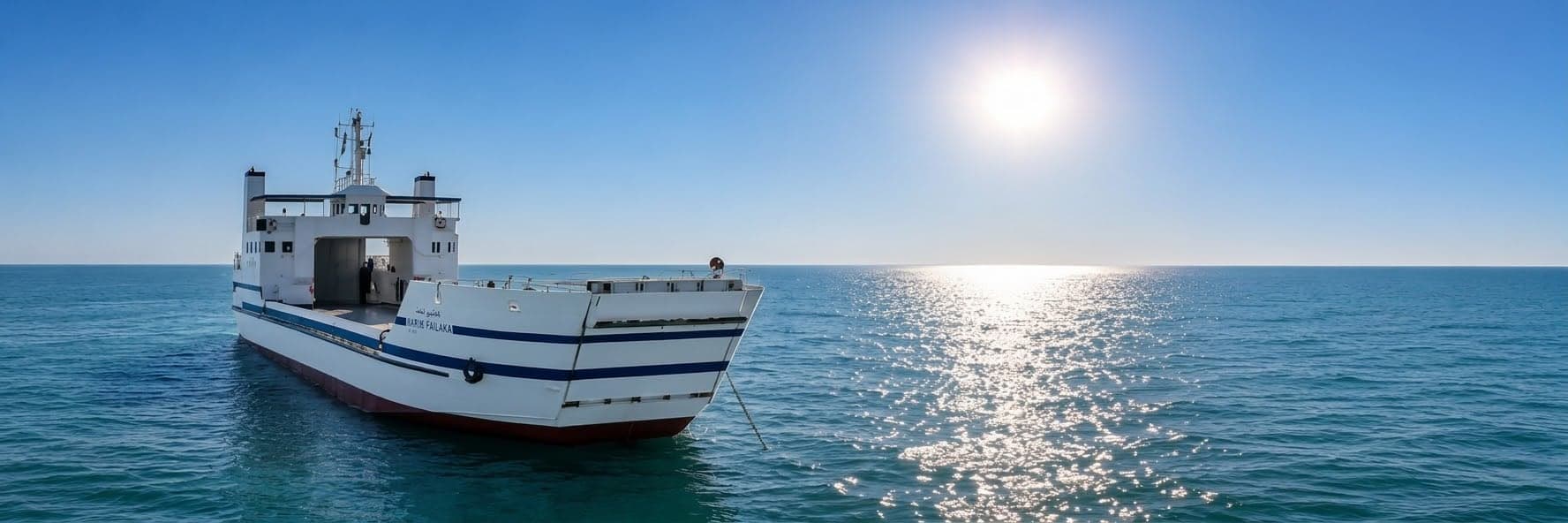
JKM is a National maritime company that strives to become the regional maritime company of choice. As a registered entity in 2005, JKM has established itself as one of the leading providers of marine transportation, logistics and marine port services in Kuwait. With the company’s stakeholders, Kuwait Public Transport company (KPTC) and Touristic Enterprises Company of Kuwait, we are proudly committed to our partners in offering innovative solutions to complex marine logistics challenges.
JKM is the National Maritime company adding value to the Kuwait Marine & Logistics Sector by providing Innovative Maritime Solutions of the Highest Quality..
To become the regional maritime company of choice: offering integrated solutions, value for customers, operating in an ethically & environmentally conscious manner, and employer of choice for a diversified multi- cultural workforce, where employees strive to maximize shareholder’s return on investments.
Our company’s core values are our fundamental beliefs that help our employers to function together as a team and work toward a common business goal. We strongly believe in our team work, responsibility, integrity, quality and leadership.

“We will add value to Kuwait maritime services by improving our local operations & preparing the company to offer logistics services regionally. Building our human capital will be key, and we promise to make our shareholders & stakeholders proud.”
— Shukri Al-Mahrous
Chief Executive Officer

Chairman of Board of Directors

Deputy Chairman of the Board

Member of the Board of Directors
The people we trust to lead our company into the future.
Chief Executive Officer


Finance Manager

The strategic location of the GCC as a gateway between Europe and Asia has created a strong logistics market in the region. Additionally, the efforts of all GCC economies to focus on diversification away from oil have further propelled JKM to explore innovative solutions.
Large-scale infrastructural developments, a booming retail industry, and a high dependence on international trade are some of the major drivers that are instrumental in the JMK’s growth story.
The GCC logistics market forms a fundamental part of the economy and grew at a brisk pace to reach a value of ~KD 24.5 billion in 2018 and continues to expand further. Given Kuwait’s strategic location and its access to the sea, Kuwait presents a wide range of opportunities in the logistics sector. JKM projects a substantial growth in the marine sector as we continue to expand the existing infrastructure and invest in the oil and gas sector.
Kuwait’s Logistics sector opportunities can be broken down into 5 major categories- Local Passenger, Vehicles, Heavy Goods Transport; Oil and Gas Logistical Support; Boat/ Yacht Rentals; Warehousing; Regional and International Shipping. Joan Al Kuwait is one of the few companies in Kuwait that managed to acquire the mandate on all five categories.
JKM is currently following a 5 Year Business Growth and Expansion Plan. The Local Passenger, Vehicles, Heavy Goods Transport backed by Ras Al Ard Marina Port Management are already well-established businesses.
Boat/ Yachts Rentals and Oil and Gas Logistical Support are being currently explored to expand JKM’s offerings of marine activities. JMK’s long-term objectives of 5 Year Business Plan include adding warehousing and Regional and International Shipping. This will be achieved through strategic investments, partnerships and international joint collaborations.
JKM’s strategy is a response to the four most important business trends in logistical industry. These being globalization, digitalization, diversity, and sustainability. The company strategizes to build on these trends to harness the potential for profitable long-term growth within in its core marine logistics businesses, at the same time stepping up the digital transformation that is already underway worldwide.
The company culture at JKM is based on the highest levels of integrity, diverse perspectives and a collaborative workplace. Through the support of various department heads, JKM always ensure its workforce is guided by JKM’s core values of quality, teamwork, responsibility, leadership, integrity, and respect. To aid in this process, JKM Management strives to create an environment that promotes a culture that places premium value on learning and training.
The company is striving to be the preferred employer of choice for prospective employees and take appropriate measures to train them, reward them, and retain them. A combination of reward and recognition will ensure JKM attracts and retains the best talent available in the Kuwait market.
The company culture at JKM is based on the highest levels of integrity and this would be built into all the employees working at the company.

Globally, the marine industry is moving past outdated practiceas to bring in process efficiency, effective use of our resources and people. Social responsibility is no longer a theoretical case but a practical necessity, with key stakeholders realizing that the way forward is moving together with the vibrant components of our vibrant community. As part of our social responsible practices, we offer: discounted ferry tickets to kids and people of determination, safe wharf to diverse sea challenges, and commitment to sea laws.

Logistics is defined as the process of planning, implementing, and managing the movement of products and information from one point to another. Logistics is a highly broad concept which involves many businesses and management related functions and also it is divided into many activities/functions which can be listed as follow: Transportation, inventory management, order processing, warehousing, customer services, handling, packaging, labeling, information management, returned product management, salvage scrap disposal, and site/location selection (Lambert, Stock, & Ellram, 1998; Ballou, 1999; Wood, Barone, Murphy, & Wardlow, 2002; Bowersox, Closs, & Cooper, 2010).

UNCTAD (2014) stated that almost 85% of international trade in products is carried at sea by the shipping industry. Thus, the shape of the world economy is highly dependent on the maritime industry. The maritime logistics functions comprise of transportation and traffic management, inventory management, demand forecasting, material handling, and packaging and labeling.

In the early eighteenth century, Kuwait prospered as a maritime port city and rapidly became the principal commercial center for the transit of goods between Baghdad, India, Muscat, and Arabian Peninsula. By the mid 1700s, Kuwait had established itself as the major trading route from the Arabian Gulf to Aleppo. During the Persian siege of Basra in 1775–79, Iraqi merchants took refuge in Kuwait and were partly instrumental in the expansion of Kuwait’s boat-building and trading activities. As a result, Kuwait’s maritime commerce boomed, as the Indian trade routes with Baghdad, Aleppo, Smyrna and Constantinople were diverted to Kuwait during this time. The East India Company was diverted to Kuwait in 1792. The East India Company secured the sea routes between Kuwait, India and the east coasts of Africa.

The East India Company was diverted to Kuwait in 1792. The East India Company secured the sea routes between Kuwait, India and the east coasts of Africa. After the Persians withdrew from Basra in 1779, Kuwait continued to attract trade away from Basra. The flight of many of Basra’s leading merchants to Kuwait continued to play a significant role in Basra’s commercial stagnation well into the 1850s. Instability in Basra helped foster economic prosperity in Kuwait. In the late 18th century, Kuwait was a haven for Basra merchants fleeing Ottoman persecution. Kuwait was the center of boat building in the Arabic Gulf, its ships renowned throughout the Indian Ocean. Kuwaitis also developed a reputation as the best sailors in the Arabic Gulf.

Corporate Planning Manager

Sr. Officer – Corporate Planning